
How to Practise Maths at Home Without Getting Overwhelmed

Your child nods along during the lesson, follows the teacher’s example and feels reasonably confident. Then they sit down with their homework at the kitchen table and everything seems to vanish. If that sounds familiar, you are not alone. This is very common, and it rarely means a student “can’t do maths”. Long sessions, difficult questions and the pressure to get everything right can make maths practice at home feel like a chore. Regular, manageable practice usually works far better than trying to finish a mountain of exercises in one evening. In this guide, we cover practical ways to practise maths, simple activities using everyday items, healthy revision habits and ways parents can support progress without adding pressure. Why Does Maths Practice Feel Overwhelming for Some Students? Maths builds on itself, so a small gap in understanding can quietly grow into a bigger problem. Some of the most common reasons students struggle at home include: Shaky understanding of basic concepts, such as place value, fractions or times tables. Attempting advanced questions before the foundations are secure. Fear of getting answers wrong. No regular study routine. Long sessions without breaks. Difficulty understanding what a question is asking. Pressure to achieve high marks quickly. Struggling with maths does not mean a student lacks ability. More often, they need a clearer explanation, more practice at the right level, or a different approach. Every child learns at their own pace, and that is perfectly normal. 8 Practical Ways to Practise Maths at Home Without Stress 1. Start with Small and Achievable Goals Choose one topic or skill at a time, such as “adding fractions with different denominators”. Getting five questions right builds more confidence than getting through twenty with constant doubt. 2. Build a Consistent Daily Maths Routine Short, regular sessions beat occasional long ones. Fifteen focused minutes most days helps knowledge stick. Adjust the length to your child’s age and needs. 3. Understand the Concept Before Memorising Formulas A student who knows why the area of a rectangle is length × width can work out other shapes more easily than one who only remembers the rule. Ask, “Why does this method work?” before moving on. 4. Break Difficult Questions into Smaller Steps Take this word problem: “A coat costs £60 and is reduced by 25%. What is the sale price?” Split it up: find 25% of £60 (£15), then subtract it (£45). Smaller steps make the problem far less intimidating. 5. Use Real-Life Examples to Learn Maths Shopping, cooking, travel times and pocket money all involve real calculations. These examples show children why maths matters. 6. Practise Different Types of Questions Mix straightforward calculations, application questions and problem-solving tasks. Each type develops a different skill. 7. Learn from Mistakes Instead of Avoiding Them A wrong answer shows exactly where to focus next. Ask your child to find the step where things went wrong and redo it, rather than rubbing it out and moving on. 8. Take Short Breaks and Celebrate Progress A five-minute break can reset a tired mind. Notice small wins too, such as finally mastering a method that felt hard last week. Simple Maths Activities Students Can Try at Home None of these need expensive resources, and they link classroom learning to everyday life: Shopping calculations: Work out a 20% discount, the total of a basket or the change from £10. Cooking measurements: Halve or double a recipe to practise fractions, ratios and converting between grams and kilograms. Time challenges: If the bus leaves at 8:47 and the walk takes 12 minutes, when should you set off? Number games: Try quick mental arithmetic, such as times tables races or “beat your best score” challenges. Measurement activities: Measure household objects, estimate first, then compare the real lengths. Budget exercises: Plan a small weekly budget, record spending and calculate what is left. Younger children may enjoy the hands-on tasks, while older students can handle percentages, ratios and multi-step budgeting. How Much Time Should Students Spend Practising Maths at Home? There is no single answer for every child. As a flexible starting point: Younger primary students: around 10–15 minutes of focused practice. Older primary students: around 15–20 minutes. Secondary school students: around 20–30 minutes, depending on workload and needs. These are suggestions, not strict rules or official recommendations. Quality matters more than quantity. Twenty minutes of careful, understanding-based practice is worth more than an hour of tired guesswork. Adjust the routine around schoolwork, attention span and energy levels, and build in breaks. How Parents Can Help Children Improve Their Maths Skills You do not need to know every method to be a great support. What helps most is: Providing a quiet, comfortable place to work. Helping your child understand what a question is asking. Asking them to explain how they reached an answer. Avoiding comparisons with siblings or classmates. Praising effort and improvement, not just correct answers. Noticing topics that keep causing trouble. Keeping conversations about difficulties calm and positive. Methods taught in school today may look different from the ones you learned. If so, ask your child to teach you. Explaining a method aloud is one of the best ways to understand it. If you are unsure, encouraging questions, protecting routines and seeking the right guidance when needed is enough. What Should Students Do When They Get Stuck on a Maths Question? Feeling stuck is part of learning. Try this approach: Read the question carefully. Identify the information given. Work out what the question is asking. Decide which concept or formula applies. Break the calculation into smaller steps. Check the answer and review any mistakes. If the same approach keeps failing, stop repeating it. Try a different method, leave the question and return later, or ask for help. A teacher, parent or tutor can often spot the missing piece within minutes. When Should You Consider Additional Maths Tuition? Home practice works well for many families, but extra support can help when: Fundamental concepts remain unclear. The same mistakes keep appearing despite regular

How to Practise Maths at Home Without Getting Overwhelmed Read Post »
How to Help Your Child Improve Their Primary School Maths Skills

If your child groans when homework comes out, says “I’m just bad at maths” or comes home confused by what they learned in class, you are far from alone. Many parents tell us the same thing, and many feel unsure how to help because the methods taught today look different from the ones they learned at school. The good news is that you do not need to be a maths expert to make a real difference. Building primary school maths skills is mostly about small, consistent habits, a positive attitude and plenty of practice that feels more like play than work. In this guide, we share practical ways to help your child improve, explain how to spot where they are struggling and suggest when extra support can help. Why Primary School Maths Skills Matter Primary school mathematics is the foundation for everything that follows. Concepts such as number recognition, place value, addition and subtraction, multiplication and division and fractions are the building blocks for secondary school maths, science and even everyday life skills like budgeting, cooking and telling the time. Maths is also cumulative. A child who misses a step, such as not fully understanding place value, may find later topics like long multiplication or fractions much harder. Small gaps left unaddressed can grow into big confidence problems, which is why early support matters so much. Start With Confidence and a Positive Mindset Before any worksheet or app, the most important thing you can do is influence how your child feels about maths. Avoid negative talk. Try not to say “I was never good at maths.” Children pick up on this and may decide it is normal to struggle. Praise effort, not just answers. Try “I like how you kept trying” rather than “You’re so clever.” Treat mistakes as part of learning. Ask, “What did you try? Where did it go wrong?” This builds resilience and problem-solving skills. Keep sessions short and relaxed. Ten to fifteen minutes of calm practice beats an hour of frustration. A child who feels safe making mistakes is far more likely to keep trying, and that is where real progress happens. Everyday Maths Learning Activities at Home You do not need to sit down with a textbook. Maths is everywhere, and daily life offers countless chances for maths learning activities that feel natural. In the kitchen Cooking is a brilliant way to practise measuring, weighing, fractions and time. Ask your child to halve a recipe, work out how many minutes are left on the timer or share a pizza into equal slices and name the fractions. At the shops Let your child add up prices, compare offers or work out change. Younger children can practise number recognition by finding prices and spotting numbers on packaging. On the move Car journeys and walks are ideal for quick mental maths for children. Try counting in twos, fives or tens, spotting numbers on houses or doubling and halving numbers as you walk. Playing games Board games, card games and dice games build number sense without feeling like homework. Snakes and ladders, dominoes, Uno and simple card games like “Snap” or “Sevens” all strengthen counting, addition and strategy. Build Strong Basic Maths Skills Step by Step Strong basic maths skills are the key to long-term success. Here is how you can support the main areas covered in primary school. Number recognition and counting (ages 5–6) Younger children need a secure understanding of numbers before moving on. Practise counting objects, ordering numbers and spotting patterns. Use everyday items like buttons, pasta shapes or toy cars so that numbers feel real and tangible. Addition and subtraction practice Encourage your child to learn number bonds, such as pairs that make 10 and 20, until they are almost automatic. Use a number line, counters or coins to make addition and subtraction visual. As confidence grows, move on to bridging through ten, then to larger numbers using column methods. Multiplication and division Help your child see that multiplication is repeated addition and that division is sharing or grouping. Arrays, such as rows of objects in a grid, are a great way to show how the two are connected. Understanding the why makes the facts easier to remember. Times tables practice In Year 4, children are expected to know their times tables up to 12 × 12, and a multiplication check is taken in school. Rather than relying on rote memory alone, try: Learning one table at a time, starting with easier ones such as 2, 5 and 10. Chanting, singing or tapping out rhythms. Using short daily bursts of five minutes rather than long sessions. Playing quick-fire games or using online times tables apps. Spotting patterns, such as the digits of the 9 times table adding up to 9. Regular, low-pressure times tables practice is one of the most effective ways to boost both speed and confidence. Fractions for primary students Fractions are a stumbling block for many children. Keep it practical: fold paper, cut fruit, share chocolate bars or use pizza and pie examples. Show that a half, two quarters and four eighths are the same amount. Visual models help children understand fractions before they work with symbols and numbers. Develop Maths Problem-Solving Skills Maths is not just about getting the right answer. It is also about thinking logically and explaining your reasoning. Strong maths problem-solving skills help children tackle word problems and unfamiliar questions without panicking. Here are some simple ways to encourage this: Ask open questions. “How did you work that out?” or “Is there another way?” encourages deeper thinking. Read word problems together. Underline key information and decide what the question is really asking. Draw it out. Sketching a quick picture or diagram often makes a problem much clearer. Estimate first. Asking “Roughly what do you think the answer will be?” helps children check whether their final answer makes sense. Let them explain. If your child can teach you how they solved something, they genuinely understand it. Make Primary

How to Help Your Child Improve Their Primary School Maths Skills Read Post »

GCSE Maths Preparation

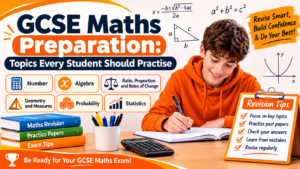
GCSE Maths Preparation: Topics Every Student Should Practise

GCSE Maths preparation goes better when you know what to practise and how to practise it. The subject is wide, and many students feel unsure where to start. The exam does return to the same core areas each year. If you build strong skills in those areas, you will feel calmer and more ready on exam day.
This guide lists the key topics, explains why each one matters, and gives simple revision tips.

GCSE Maths Preparation: Topics Every Student Should Practise Read Post »

Scroll to Top