
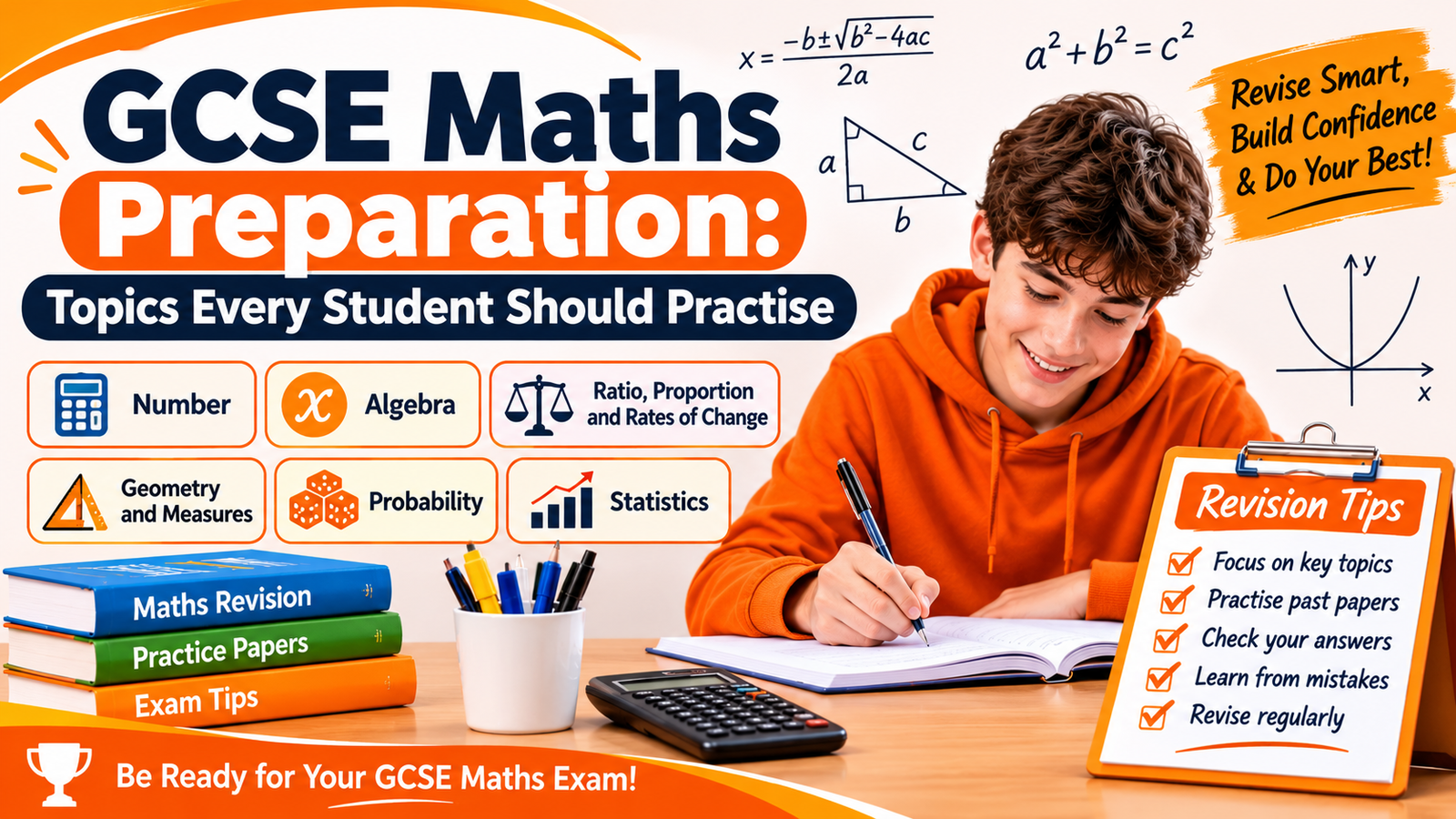
GCSE Maths preparation goes better when you know what to practise and how to practise it. The subject is wide, and many students feel unsure where to start. The exam does return to the same core areas each year. If you build strong skills in those areas, you will feel calmer and more ready on exam day.
This guide lists the key topics, explains why each one matters, and gives simple revision tips.
Table of Contents
How the GCSE Maths Exam Is Set Out
Most students sit three papers. One paper has no calculator, and two allow a calculator. All three cover the same six areas:
- Number
- Algebra
- Ratio, proportion and rates of change
- Geometry and measures
- Probability
- Statistics
Papers are set at Foundation tier (grades 1 to 5) or Higher tier (grades 4 to 9). Your teacher will tell you which tier suits you. The topics below matter at both tiers, but Higher tier questions are harder in each area.
1. Number
Number skills sit under everything else in maths. Weak number skills slow you down in every paper, and they matter most when you cannot use a calculator.
Practise:
- Fractions, decimals and percentages, and how to switch between them
- Order of operations (BIDMAS)
- Factors, multiples, primes, HCF and LCM
- Powers, roots and standard form
- Rounding, estimating and bounds
Tip: Spend ten minutes a day on mental maths. Times tables and quick percentage steps (10%, 5% and 1%) save time in the exam.
2. Algebra
Algebra carries a large share of the marks. It also links to graphs, geometry and problem-solving questions, so it pays to get comfortable with it early.
Practise:
- Simplifying expressions and collecting like terms
- Expanding brackets and factorising
- Solving linear equations
- Rearranging formulae
- Solving quadratic equations
- Simultaneous equations
- Inequalities
- Sequences and the nth term
Tip: Write down every step. If you make a slip, you can still earn method marks, and you will find the error faster.
3. Ratio, Proportion and Rates of Change
These questions use everyday settings such as recipes, money, speed and sharing. Many students lose marks here by reading too fast.
Practise:
- Simplifying and sharing in a ratio
- Direct and inverse proportion
- Percentage increase and decrease
- Reverse percentages
- Compound interest and depreciation
- Speed, distance and time
- Density and pressure
Tip: Underline the key numbers and write what you need to find before you start.
4. Geometry and Measures
Geometry tests shapes, angles and space. You need to know the rules and when to use them.
Practise:
- Angle rules in triangles, parallel lines and polygons
- Area and perimeter, including circles
- Volume and surface area of 3D shapes
- Pythagoras’ theorem
- Trigonometry (sine, cosine and tangent)
- Reflection, rotation, translation and enlargement
- Constructions and loci
- Circle theorems and vectors (Higher tier)
Tip: Sketch a diagram, even when the question gives one, and label it with the numbers you know.
5. Probability
Probability questions are often short, and the marks are easy to win with practice.
Practise:
- The 0 to 1 probability scale
- Listing outcomes and sample space diagrams
- Tree diagrams for combined events
- Venn diagrams and set notation
- Independent and dependent events
- Conditional probability (Higher tier)
Tip: Check that your probabilities add up to 1. This quick test catches many errors.
6. Statistics
Statistics questions ask you to read, draw and explain data.
Practise:
- Mean, median, mode and range
- Frequency tables and grouped data
- Pie charts, bar charts and line graphs
- Scatter graphs and lines of best fit
- Cumulative frequency and box plots
- Histograms (Higher tier)
- Sampling methods
Tip: When a question says “compare”, use a number from each data set and write a full sentence.
How to Revise These Topics Well
Knowing the topics is the first step. How you practise them is the next.
- Start with your weakest areas. It feels good to revise what you know, but marks rise fastest when you fix gaps.
- Write your answers by hand. The exam is on paper, so practise on paper. Clear working and tidy presentation help you spot mistakes and help the examiner follow your method.
- Use past papers. They show the style of questions and how marks are given. Time yourself so the real paper feels familiar.
- Mark your own work. Use the mark scheme and note where you lost marks. Was it a careless slip, a missing step or a topic you do not understand?
- Keep a mistakes log. Write each error and the right method. Read it before every practice session.
- Practise little and often. Thirty to forty-five minutes a few times a week works better than one long session just before the exam.
- Learn the formulae. Some are given on the paper and some are not. Ask your teacher which ones to memorise, then test yourself with flashcards.
- Try mixed questions. Many questions blend topics, such as algebra inside a geometry problem. Practise choosing the method yourself.
Tips for Exam Day
- Read each question twice before you write.
- Show your working, even on short questions.
- Check that your answer makes sense. A person cannot be 400 metres tall.
- Do not spend too long on one question. Move on and come back to it.
- Leave a few minutes at the end to check your calculations and units.
- Pack a calculator, spare batteries and your geometry tools.
When Extra Help Can Make a Difference
Some topics need more than self-study. If you keep getting stuck on the same type of question, help from a tutor can close the gap.
For students in Leicester, Bright Learning Centre offers Maths tuition for ages 5 to 16, up to GCSE level. Lessons are classroom-based and use worksheets, and students work with pen and paper, which matches how the GCSE is sat. Tutors explain each topic, set new worksheets in each session and give regular homework. Students can join a small group or have one-to-one sessions.
The centre also offers a free assessment. It shows a student’s strengths and any learning gaps, so revision can start with the topics that need the most work. Parents also get feedback on progress through monthly meetings.
Final Thoughts
GCSE Maths preparation does not need to feel like too much. Focus on the six main areas: number, algebra, ratio and proportion, geometry, probability and statistics. Practise a little each week, learn from your mistakes, and test yourself with past papers.
Start today. Pick one topic from this list, do ten practice questions and check your answers. Small steps add up. If you would like support along the way, Bright Learning Centre is ready to help students across Leicester build skill and confidence in Maths. You can book a free assessment or call 0116 21010 70.
Frequently Asked Questions
How many hours should I spend on GCSE Maths revision?
There is no set number. Most students do well with three to five short sessions each week, then add more in the weeks before the exam.
Which GCSE Maths topics carry the most marks?
Algebra, number, and ratio and proportion make up a large share of the marks. Geometry, probability and statistics matter too, so cover all six areas.
Is it better to revise by hand or on a screen?
The exam is paper-based, so writing out answers by hand is good practice. It helps you build neat working and keeps your exam skills sharp.
Can small group tuition help with GCSE Maths?
Yes, many students feel more at ease in a small group than in a large class. They can ask questions freely and get more attention from the tutor.
What if I need to resit GCSE Maths?
The same six topic areas apply. Look at your last paper, find where you lost marks, and focus your revision there.