
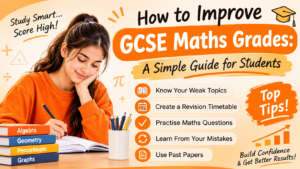
How to Improve GCSE Maths Grades: A Simple Guide for Students
GCSE Maths is an important subject for students, but getting good marks is not always easy. Some students understand the lessons in class but struggle when they try to answer questions on their own. Others find certain topics difficult, make small mistakes in exams or run out of time before completing the paper. These problems can affect their confidence and make Maths feel harder than it needs to be. The good news is that students can improve their Maths grades with regular practice, a clear study plan and the right support. They do not need to spend hours studying every day. Small steps, such as practising a few questions, reviewing mistakes and learning how to solve problems, can make a big difference over time. If you are wondering how to improve GCSE Maths grades, this guide shares practical tips that students can follow at home and school. It also explains how parents can support their children and when extra tuition may help. Table of Contents Understand Which GCSE Maths Topics You Find Difficult Create a Simple GCSE Maths Revision Timetable Practise Maths Questions Every Day Learn From Your Mistakes Use GCSE Maths Past Papers for Practice Understand the Maths Methods Instead of Memorising Answers Improve Your Time Management During Exams Learn How to Answer Word Problems Ask for Help When You Do Not Understand a Topic Use Online Resources to Support GCSE Maths Revision Build Confidence With Small Learning Goals How Parents Can Help Their Children Improve GCSE Maths Grades How Can GCSE Maths Tuition Help Students Improve? Frequently Asked Questions About Improving GCSE Maths Grades Final Thoughts 1. Understand Which GCSE Maths Topics You Find Difficult Before starting revision, students should understand which parts of Maths they find difficult. Trying to study every topic at once can feel confusing and waste time. Some students are good at basic calculations but struggle with algebra. Others find geometry, graphs or word problems more challenging. Start by making a list of topics that need more attention. For example: Algebra: Practise solving equations, simplifying expressions and working with unknown numbers. Fractions: Learn how to add, subtract, multiply and divide fractions. Percentages: Practise percentage increases, decreases and finding percentages of amounts. Geometry: Understand angles, shapes, area, perimeter and volume. Graphs: Learn how to read, draw and understand different types of graphs. Ratio and proportion: Practise sharing amounts and comparing quantities. Probability: Learn how to calculate the chances of different events. Once students know their weak areas, they can spend more time practising those topics instead of repeating questions they already understand. 2. Create a Simple GCSE Maths Revision Timetable A revision timetable helps students organise their study time. Without a plan, it is easy to leave difficult topics until the last minute. Students should create a timetable that fits around school, homework and other activities. There is no need to study Maths for several hours every day. A simple weekly plan could look like this: Day Revision topic Monday Algebra Tuesday Fractions and decimals Wednesday Percentages Thursday Geometry Friday Ratio and proportion Saturday GCSE Maths practice paper Sunday Review mistakes and revise weak topics Students can spend around 30 to 45 minutes on each revision session, depending on their needs. It is also important to take short breaks. Studying for a long time without rest can make it harder to remember information. 3. Practise Maths Questions Every Day Reading Maths notes is helpful, but it is not enough to improve exam results. Students need to solve questions themselves. Regular practice helps students understand how different questions work. It also makes them more comfortable with using formulas and following calculation steps. A good way to practise is to: Choose one Maths topic. Read through an example question. Try a few questions without looking at the answer. Check the answers carefully. Repeat the questions that were difficult. For example, if a student is struggling with percentages, they can practise finding 10%, 20% and 25% of different amounts before moving on to harder questions. Starting with easier questions helps build confidence. Students can then move towards more difficult problems as their understanding improves. 4. Learn From Your Mistakes Making mistakes is a normal part of learning Maths. However, students should not ignore their wrong answers or move straight to the next question. Every mistake can help them understand what needs more practice. For example, a student may get an algebra question wrong because they have made a calculation error. Another student may understand the calculation but use the wrong method. Both mistakes need different types of practice. One useful method is to keep a Maths mistake notebook. Students can write down: The question they got wrong. The correct answer. The step where they made a mistake. An explanation of the correct method. Another similar question to practise. They should return to this notebook regularly. Looking at previous mistakes can help students avoid repeating them in future tests. 5. Use GCSE Maths Past Papers for Practice Past papers are one of the most useful resources for GCSE Maths revision. They help students understand the types of questions that may appear in their exams. They also give students an idea of how questions are worded and how marks are awarded. When practising past papers, students should: Choose a paper that matches their exam board. Complete questions without looking at the answers. Use a timer to practise working within exam time. Check their answers using the mark scheme. Review questions they could not answer. Students should not only focus on their total marks. They should also look at the questions they got wrong and understand why. Practising past papers under timed conditions can also help students become more confident before their GCSE exams. 6. Understand the Maths Methods Instead of Memorising Answers Memorising formulas and answers may help with some questions, but it does not always work when the exam includes a problem that students have not seen before. Students should understand why a method works and how to
How to Improve GCSE Maths Grades: A Simple Guide for Students Read Post »