
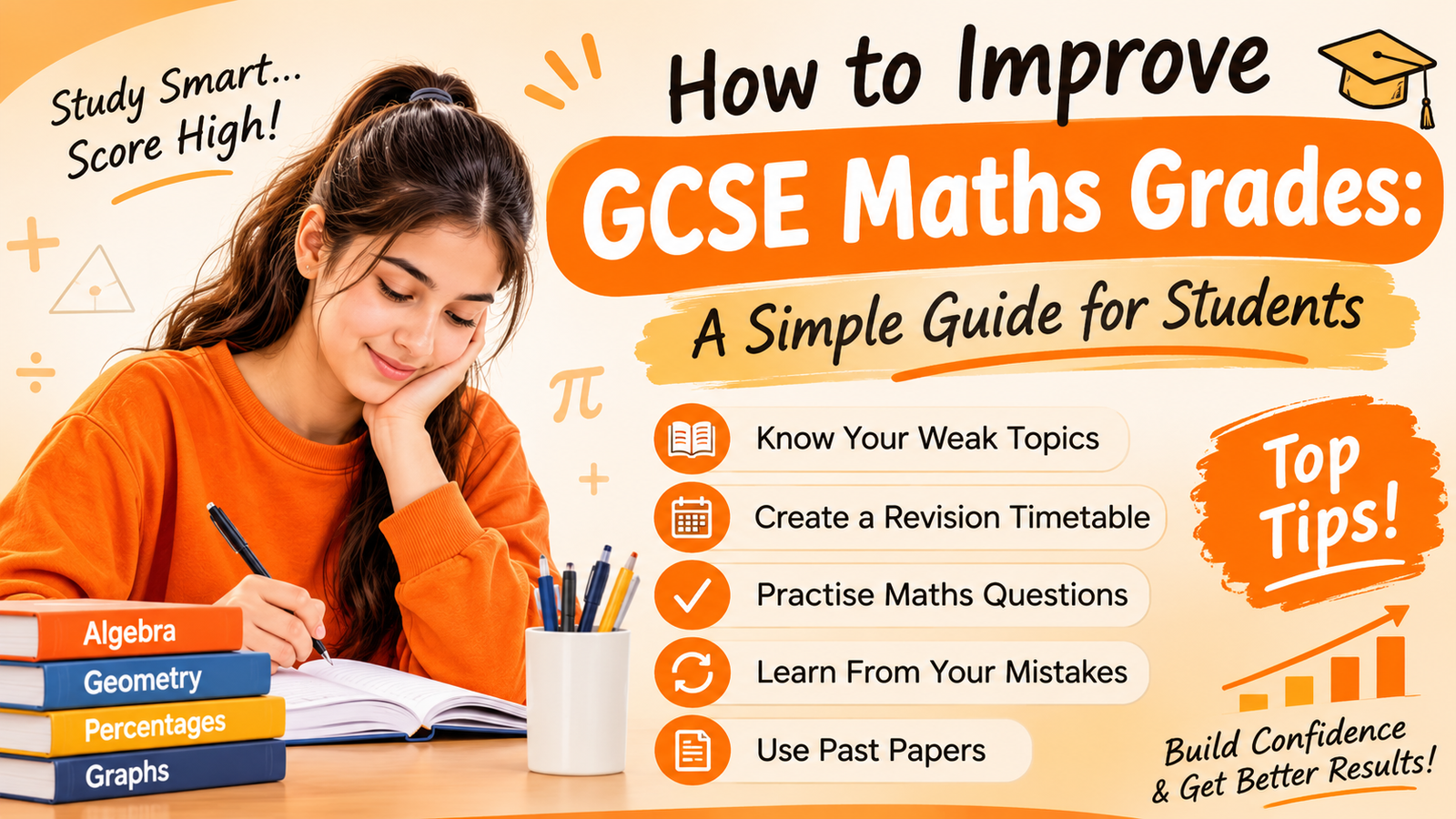
GCSE Maths is an important subject for students, but getting good marks is not always easy. Some students understand the lessons in class but struggle when they try to answer questions on their own. Others find certain topics difficult, make small mistakes in exams or run out of time before completing the paper. These problems can affect their confidence and make Maths feel harder than it needs to be.
The good news is that students can improve their Maths grades with regular practice, a clear study plan and the right support. They do not need to spend hours studying every day. Small steps, such as practising a few questions, reviewing mistakes and learning how to solve problems, can make a big difference over time.
If you are wondering how to improve GCSE Maths grades, this guide shares practical tips that students can follow at home and school. It also explains how parents can support their children and when extra tuition may help.
Table of Contents
- Understand Which GCSE Maths Topics You Find Difficult
- Create a Simple GCSE Maths Revision Timetable
- Practise Maths Questions Every Day
- Learn From Your Mistakes
- Use GCSE Maths Past Papers for Practice
- Understand the Maths Methods Instead of Memorising Answers
- Improve Your Time Management During Exams
- Learn How to Answer Word Problems
- Ask for Help When You Do Not Understand a Topic
- Use Online Resources to Support GCSE Maths Revision
- Build Confidence With Small Learning Goals
- How Parents Can Help Their Children Improve GCSE Maths Grades
- How Can GCSE Maths Tuition Help Students Improve?
- Frequently Asked Questions About Improving GCSE Maths Grades
- Final Thoughts
1. Understand Which GCSE Maths Topics You Find Difficult
Before starting revision, students should understand which parts of Maths they find difficult. Trying to study every topic at once can feel confusing and waste time.
Some students are good at basic calculations but struggle with algebra. Others find geometry, graphs or word problems more challenging.
Start by making a list of topics that need more attention. For example:
- Algebra: Practise solving equations, simplifying expressions and working with unknown numbers.
- Fractions: Learn how to add, subtract, multiply and divide fractions.
- Percentages: Practise percentage increases, decreases and finding percentages of amounts.
- Geometry: Understand angles, shapes, area, perimeter and volume.
- Graphs: Learn how to read, draw and understand different types of graphs.
- Ratio and proportion: Practise sharing amounts and comparing quantities.
- Probability: Learn how to calculate the chances of different events.
Once students know their weak areas, they can spend more time practising those topics instead of repeating questions they already understand.
2. Create a Simple GCSE Maths Revision Timetable
A revision timetable helps students organise their study time. Without a plan, it is easy to leave difficult topics until the last minute.
Students should create a timetable that fits around school, homework and other activities. There is no need to study Maths for several hours every day.
A simple weekly plan could look like this:
| Day | Revision topic |
|---|---|
| Monday | Algebra |
| Tuesday | Fractions and decimals |
| Wednesday | Percentages |
| Thursday | Geometry |
| Friday | Ratio and proportion |
| Saturday | GCSE Maths practice paper |
| Sunday | Review mistakes and revise weak topics |
Students can spend around 30 to 45 minutes on each revision session, depending on their needs.
It is also important to take short breaks. Studying for a long time without rest can make it harder to remember information.
3. Practise Maths Questions Every Day
Reading Maths notes is helpful, but it is not enough to improve exam results. Students need to solve questions themselves.
Regular practice helps students understand how different questions work. It also makes them more comfortable with using formulas and following calculation steps.
A good way to practise is to:
- Choose one Maths topic.
- Read through an example question.
- Try a few questions without looking at the answer.
- Check the answers carefully.
- Repeat the questions that were difficult.
For example, if a student is struggling with percentages, they can practise finding 10%, 20% and 25% of different amounts before moving on to harder questions.
Starting with easier questions helps build confidence. Students can then move towards more difficult problems as their understanding improves.
4. Learn From Your Mistakes
Making mistakes is a normal part of learning Maths. However, students should not ignore their wrong answers or move straight to the next question.
Every mistake can help them understand what needs more practice.
For example, a student may get an algebra question wrong because they have made a calculation error. Another student may understand the calculation but use the wrong method. Both mistakes need different types of practice.
One useful method is to keep a Maths mistake notebook. Students can write down:
- The question they got wrong.
- The correct answer.
- The step where they made a mistake.
- An explanation of the correct method.
- Another similar question to practise.
They should return to this notebook regularly. Looking at previous mistakes can help students avoid repeating them in future tests.
5. Use GCSE Maths Past Papers for Practice
Past papers are one of the most useful resources for GCSE Maths revision. They help students understand the types of questions that may appear in their exams.
They also give students an idea of how questions are worded and how marks are awarded.
When practising past papers, students should:
- Choose a paper that matches their exam board.
- Complete questions without looking at the answers.
- Use a timer to practise working within exam time.
- Check their answers using the mark scheme.
- Review questions they could not answer.
Students should not only focus on their total marks. They should also look at the questions they got wrong and understand why.
Practising past papers under timed conditions can also help students become more confident before their GCSE exams.
6. Understand the Maths Methods Instead of Memorising Answers
Memorising formulas and answers may help with some questions, but it does not always work when the exam includes a problem that students have not seen before.
Students should understand why a method works and how to use it in different situations.
For example, when learning how to calculate the area of a triangle, students should understand that they need the base and perpendicular height. The formula is:
Area of a triangle = ½ × base × height
After learning the formula, they should practise questions with different numbers and measurements.
Understanding the method makes it easier to solve unfamiliar questions and reduces the need to memorise every example.
7. Improve Your Time Management During Exams
Some students know how to solve Maths questions but struggle to finish their exam paper on time.
This can happen when they spend too long on one difficult question or do not plan their time carefully.
Good time management can help students attempt more questions and make better use of the exam time. Here are some useful tips:
- Read each question carefully before answering.
- Start with questions you understand.
- Do not spend too long on one difficult question.
- Show your working steps clearly.
- Leave time to check your answers.
- Return to unanswered questions if time allows.
Students should also practise completing full past papers within the given time. This helps them become familiar with exam conditions.
8. Learn How to Answer Word Problems
Word problems can be difficult because students need to understand the information before choosing the correct calculation.
For example, a question may describe a shopping discount, a journey or the cost of several items. Students must work out what the question is asking before starting the calculation.
A simple approach is to:
- Read the question slowly.
- Identify the important numbers.
- Look for what needs to be calculated.
- Decide which Maths method to use.
- Show the working clearly.
- Check whether the answer makes sense.
Students should practise different types of word problems because these questions test both Maths knowledge and problem-solving skills.
9. Ask for Help When You Do Not Understand a Topic
Some students spend too much time trying to solve difficult questions on their own. While independent practice is important, asking for help can save time and prevent confusion.
Students can ask their school teacher to explain a topic again or discuss difficult questions with a parent, classmate or tutor.
For example, if a student keeps getting questions about simultaneous equations wrong, they may need someone to explain the steps in a different way.
A good explanation can help students understand the method and practise it with confidence. Getting support early is better than waiting until the exam is close.
10. Use Online Resources to Support GCSE Maths Revision
Online learning resources can give students more opportunities to practise Maths outside school.
They can use online videos, revision websites, practice questions and educational tools to understand topics they find difficult.
However, students should choose resources that match their GCSE level and exam board. Some useful ways to use online learning include:
- Watching videos that explain difficult Maths topics.
- Downloading practice worksheets.
- Completing online Maths quizzes.
- Using GCSE past papers.
- Checking answers and reading explanations.
Students can also use AI learning tools to ask questions and get explanations. However, they should always check their answers and make sure they understand the working rather than copying the final result.
11. Build Confidence With Small Learning Goals
A lack of confidence can make Maths feel more difficult. Some students become worried about getting questions wrong and stop trying.
The best way to build confidence is to set small and realistic goals. For example, a student could aim to understand one algebra topic during the week or complete ten practice questions each day.
They should also recognise their progress. If a student could not solve a particular question last week but can now answer it independently, that is a positive step.
Parents can help by encouraging their children, recognising their efforts and avoiding unnecessary pressure.
12. How Parents Can Help Their Children Improve GCSE Maths Grades
Parents play an important role in supporting their children's education. Even if they cannot help with every Maths question, they can create a positive learning environment at home.
Here are some practical ways parents can help:
- Create a quiet study space. Give your child a comfortable place to study without unnecessary distractions. A desk, notebook, calculator and other basic learning materials can make revision easier.
- Encourage regular practice. Help your child follow a simple revision routine. Short and regular sessions are often easier to manage than long study sessions.
- Talk about difficult topics. Ask your child which Maths topics they find difficult. This can help you understand where they need extra support.
- Celebrate progress. Praise your child's effort when they complete difficult questions or improve their test results. This can help them feel more confident.
- Consider extra tuition. If your child continues to struggle with Maths despite regular practice, extra learning support may be useful. A tutor can explain topics step by step and give students more opportunities to practise.
How Can GCSE Maths Tuition Help Students Improve?
Some students need more support than they can get during normal classroom lessons. They may find it difficult to follow the pace of the class or may need extra time to understand certain topics.
GCSE Maths tuition can provide additional learning support based on a student's needs.
A tutor can help students:
- Understand difficult Maths topics.
- Practise questions at their current learning level.
- Improve problem-solving skills.
- Prepare for GCSE Maths exams.
- Identify mistakes and learn the correct methods.
- Build confidence through regular practice.
At Bright Learning Centre, students can explore tuition support to improve their English and Maths skills. With suitable guidance and regular practice, learners can work towards their academic goals.
If your child needs additional help with Maths, visit our Tuition Centre in Leicester to learn more about the available learning support.
Frequently Asked Questions About Improving GCSE Maths Grades
How can I improve my GCSE Maths grade quickly?
Start by identifying your weakest topics and practising them regularly. Use GCSE past papers, review mistakes and ask for help when you do not understand a method. A clear revision plan can help you make better use of your study time.
How many hours should I study GCSE Maths every day?
There is no fixed number of hours for every student. Around 30 to 45 minutes of focused Maths practice can be a useful starting point. Students can increase their revision time as exams get closer, while still taking regular breaks.
Are GCSE Maths past papers enough to get a good grade?
Past papers are very useful, but they should not be the only revision method. Students also need to understand the topics, learn formulas and practise different types of questions. Reviewing mistakes is just as important as completing the papers.
Which GCSE Maths topics should I revise first?
Start with topics you find difficult and those that form the foundation for other areas of Maths. These may include fractions, percentages, algebra, ratio, geometry and graphs. Your teacher can also help you decide which topics need more attention.
Can a Maths tutor help improve GCSE grades?
Yes. A Maths tutor can explain difficult topics, provide extra practice and help students understand where they are making mistakes. Regular support can help students improve their knowledge and confidence.
When should students start preparing for GCSE Maths exams?
Students should build good Maths habits throughout the school year rather than waiting until the final weeks. Starting revision early gives them more time to understand difficult topics, practise past papers and improve their weaker areas.
Final Thoughts
Improving GCSE Maths results takes time, patience and regular practice. Students should focus on understanding difficult topics, following a revision timetable, solving practice questions and learning from their mistakes. They should also remember that asking for help is a positive step when they are struggling.
If you are looking for practical ways how to improve GCSE Maths grades, start with small daily goals and keep building your skills. With regular effort, the right learning support and guidance from teachers or tutors, students can become more confident in Maths and work towards better GCSE results.
Bright Learning Centre supports learners who want to improve their English and Maths skills through additional tuition and learning guidance in Leicester.